
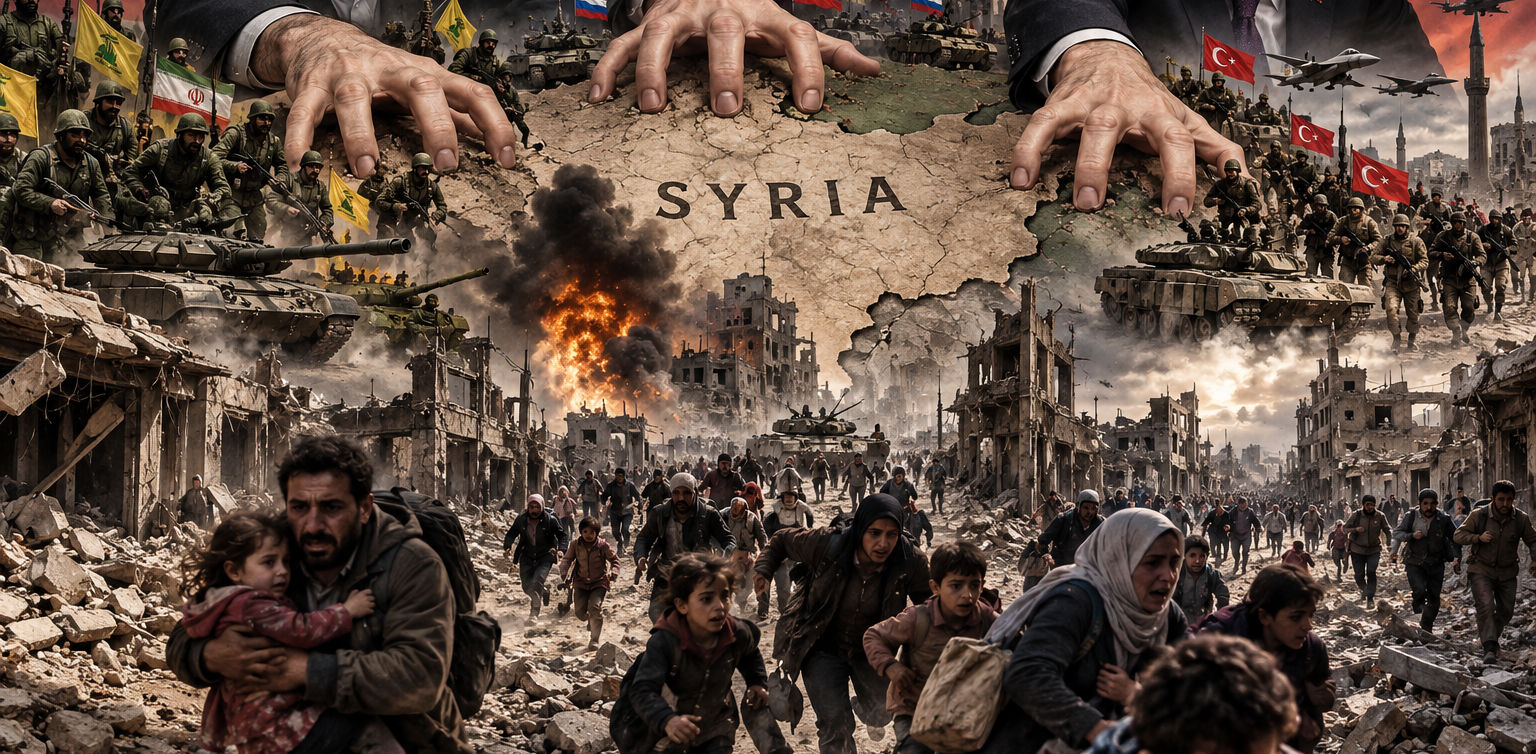
SYRIA AFTER THE FALL
Analytical scope: This report concerns Syria only. It distinguishes between the former government of Bashar al-Assad, which collapsed on December 8, 2024, and the transitional authorities led by President Ahmed al-Sharaa during 2025 and 2026. References to Iran, Russia, China, Türkiye, Israel, the United States or other states are included only where documented activity directly affects Syrian security, sovereignty, infrastructure, finance or human rights.
The Iron Triangle in this analytical framework remains China, Russia and Iran. Syria is not a fourth side of that triangle. Under Assad, Syria was heavily dependent on Russia and Iran, while China maintained a more limited economic and diplomatic role. After Assad's fall, that structure fractured and Syria began repositioning itself between Gulf states, Türkiye, Western governments and the remnants of Russian and Iranian influence.
PART I: TRANSITIONAL JUSTICE, SECTARIAN KILLINGS, DEATH SENTENCES, WOMEN, MINORITIES AND THE STRUGGLE TO REBUILD THE STATE
The Assad State Fell, but Syria's Accountability Crisis Did Not
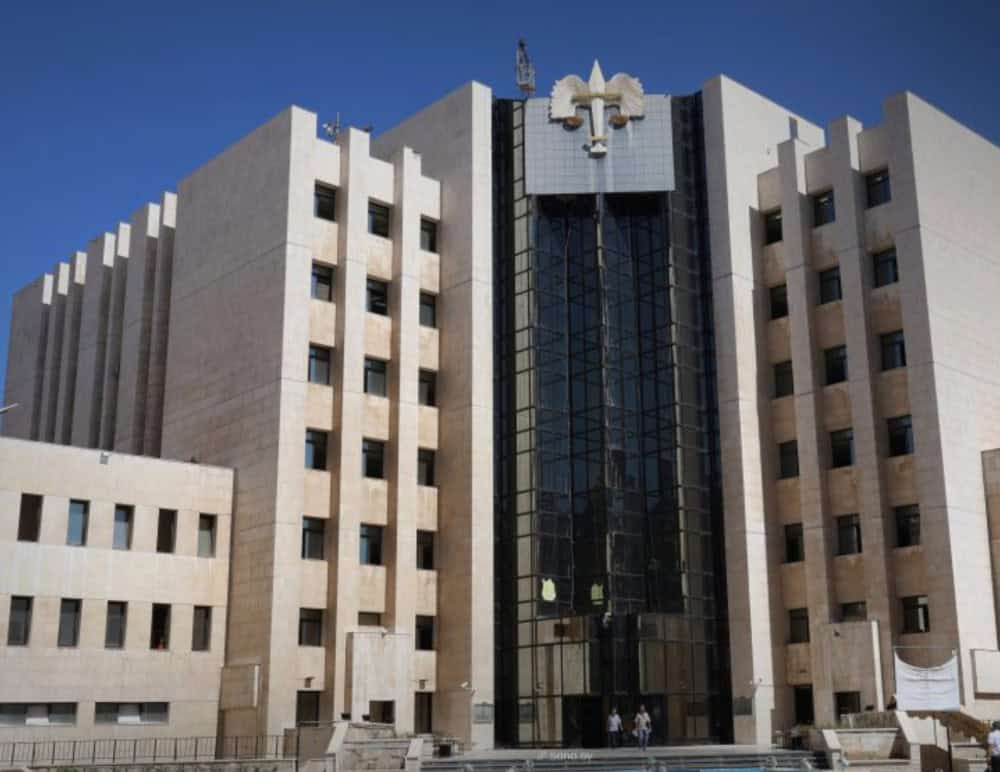
The overthrow of Bashar al-Assad on December 8, 2024 ended more than five decades of Baathist rule and dismantled one of the Middle East's most extensive systems of political detention, torture and enforced disappearance.
But the collapse of the old state did not automatically produce an accountable new one.
Syria's transitional authorities established a five-year political transition under President Ahmed al-Sharaa. A constitutional declaration adopted in March 2025 gave the executive significant control over judicial and legislative appointments, prompting concerns about weak checks and balances.Human Rights Watch
In May 2025, the government established a Transitional Justice Commission and a National Commission for the Missing. These institutions are potentially significant because the Assad-era system left more than a decade of torture files, detention records, mass graves, missing-person cases and unresolved property seizures.
The challenge is scale.
Syria is not investigating hundreds of cases.
It is confronting the accumulated consequences of a conflict involving mass imprisonment, chemical attacks, torture centers, forced displacement, sieges, disappearances and killings carried out by multiple actors over more than a decade.
The First Assad-Era Verdicts
On August 11, 2026, a Damascus court delivered the first major domestic verdict addressing senior Assad-era crimes.
Former president Bashar al-Assad, his brother Maher al-Assad and former security official Atef Najib were sentenced to death in proceedings involving murder, torture, arbitrary detention and crimes against humanity. Assad and several others were tried in absentia; Najib was in Syrian custody.Reuters
Human Rights Watch welcomed efforts to prosecute Assad-era crimes but warned that Syria's legal system still lacks the institutional guarantees required for independent, impartial and comprehensive transitional justice.Human Rights Watch
The death sentences also create an extradition problem.
States that prohibit capital punishment may be reluctant to extradite suspects if they face execution.
Thus a policy intended to demonstrate accountability may complicate the very process required to bring defendants back to Syria.
How Many People Face Execution in 2026?
There is no reliable national death-row registry for Syria in 2026.
The publicly documented August case establishes at least three high-profile death sentences, but it does not establish a complete national total.
Any report claiming that exactly hundreds or thousands of people currently await execution would require judicial records that are not publicly available.
The more accurate conclusion is:
Capital punishment remains legally available in Syria, high-profile death sentences resumed in transitional-justice proceedings in 2026, but no independently verifiable national death-row total exists.
The March 2025 Coastal Massacres
The most severe domestic violence of the transition occurred in Syria's coastal provinces in March 2025.
After attacks by former Assad-aligned fighters against government personnel, transitional security forces, affiliated armed groups and mobilized fighters entered predominantly Alawite areas in Latakia, Tartous and Hama.
Human Rights Watch reported that at least 1,400 people were killed during the resulting violence, much of it involving Alawite civilians. The UN Commission of Inquiry concluded that abuses may have constituted war crimes.Human Rights Watch
A Reuters investigation independently identified 1,479 Alawites killed across 40 locations and traced chains of command connecting some perpetrators to armed structures operating alongside the new authorities. Reuters interviewed more than 200 victims' families as well as commanders, officials and investigators.Yahoo
Documented abuses included summary executions, property destruction, looting, sectarian humiliation and burning of homes.
These killings became the first major test of the new government's promise that the post-Assad order would protect minorities.
Sweida and the Druze Crisis
The second major test came in July 2025.
Fighting in Sweida involved Druze armed groups, Bedouin fighters and government security forces.
Government forces entered the province claiming to restore order. Residents and human-rights monitors reported summary executions, sectarian abuse, looting and burning of homes.
Human Rights Watch cited UN experts who reported around 1,000 deaths, including at least 539 Druze civilians, 39 women and 21 children, and at least 196 documented extrajudicial executions. More than 33 villages were reportedly burned.Human Rights Watch
A subsequent UN investigation cited by Reuters in 2026 placed the death toll above 1,700, involving civilians and potential war crimes committed by multiple parties, including government personnel, tribal fighters and Druze armed groups.Reuters
By June 2026, the UN said a roadmap intended to reintegrate Sweida had made essentially no progress.
This is not a peripheral regional dispute.
It exposes the central question facing Syria's transition:
Can Damascus rebuild a national state without replacing one form of coercive centralization with another?
Alawites, Druze, Kurds and Christians
The transition has produced different risks for different communities.
Alawites remain associated in popular memory with the former Assad state despite the fact that many Alawites had no role in regime crimes. Collective punishment or sectarian retaliation against them is therefore a major risk.
Druze communities remain politically divided and distrustful of Damascus following the Sweida violence.
Kurds entered a new political phase in January 2026 when the government and the Syrian Democratic Forces reached an integration agreement. The arrangement provides for incorporation of SDF structures into Syrian state institutions and recognizes Kurdish cultural and linguistic rights.Reuters
Christians remain concerned about security, political representation and the ideological character of the new state.
The government therefore confronts a difficult legitimacy equation.
A unified Syria cannot be achieved simply through military integration.
It requires communities to believe that state institutions will protect them equally.
Women's Political Representation
Women remain significantly underrepresented in Syria's transitional institutions.
When the new parliament met for the first time in July 2026, Reuters reported that women held only around 10 percent of seats, with many female members entering through presidential appointments rather than regional selection.Reuters
Women continue to face discriminatory personal-status laws, economic insecurity and the effects of displacement.
The conflict has also left large numbers of women as heads of household, widows, detainee relatives or relatives of missing persons.
Their exclusion from transitional decision-making is therefore especially consequential because women disproportionately carry the social burden of the war.
Arbitrary Detention Did Not End With Assad
The closure of Assad-era prisons was one of the most dramatic symbols of December 2024.
Yet new detention concerns emerged under the transitional authorities.
Human Rights Watch documented arbitrary detention, allegations of torture and ill-treatment, journalist detentions and deaths in custody during 2025.Human Rights Watch
The Kurdish-led SDF also continued arbitrary detention in areas under its control and remained responsible for camps and detention facilities holding tens of thousands of alleged ISIS members and relatives.
The lesson is important:
A revolution can close one detention system while creating another unless the legal architecture changes with the government.
PART II: DIGITAL CONTROL AFTER ASSAD, LEGACY DPI SYSTEMS, FOREIGN TECHNOLOGY, INTERNATIONAL FIBER ROUTES AND THE NEW CONNECTIVITY RACE
Syria's Internet Architecture Must Be Divided Into Two Eras
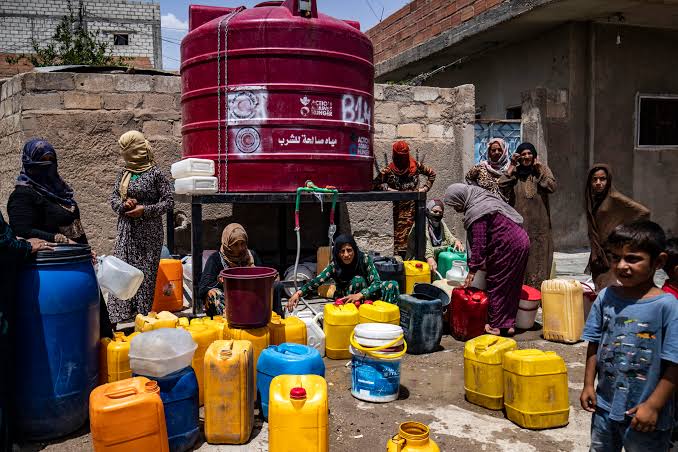
Syria's digital-control history cannot be analyzed as one continuous 2025 to 2026 censorship system.
There are two distinct periods:
The Assad surveillance state, before December 2024.
The transitional network environment, after Assad's fall.
The first is well documented.
The second is still evolving.
This distinction prevents old technical evidence from being falsely presented as proof of current government behavior.
Assad's Internet Surveillance System
Under Bashar al-Assad, Syria operated a highly centralized telecommunications environment through the Syrian Telecommunications Establishment and closely controlled service providers.
The government used commercial filtering and surveillance technology to monitor political opposition, block content and identify users.
Citizen Lab documented the presence of Blue Coat Systems devices inside Syrian telecommunications networks during the 2011 uprising. Blue Coat eventually acknowledged that at least 13 of its devices had reached Syria after being sold through a distributor in Dubai and reportedly represented as destined for the Iraqi Ministry of Communications.The Citizen Lab
Citizen Lab later identified additional Blue Coat appliances on Syrian network addresses, including SG8100-series devices.The Citizen Lab
These systems could provide filtering, proxying, web categorization and traffic-management capabilities.
The Western Supply-Chain Lesson
The Blue Coat case remains one of the clearest historical examples of how commercial Western technology can reach an authoritarian surveillance environment through intermediary distribution.
The chain was not simply:
American manufacturer, Syrian government.
It involved intermediaries, distribution channels and disputed end-user information.
Historical reporting also linked Italian company Area SpA to an effort to build an extensive monitoring system for Syria using equipment associated with companies including Blue Coat, NetApp and Sophos.Refworld
The lesson is relevant today even though the companies and government have changed.
Export controls can fail when the real end user is concealed.
What DPI Can Do
A Deep Packet Inspection system can examine traffic characteristics including:
Source address, destination address, DNS request, transport protocol, TLS handshake, exposed server name, packet timing, packet length, application signatures and VPN behavior.
A state or operator may then:
Block traffic, throttle connections, redirect DNS, reset sessions, prioritize approved services or log user activity.
But there is currently no credible public technical evidence showing that the 2025 to 2026 transitional Syrian government deployed a newly documented nationwide DPI architecture comparable to China's Great Firewall or Russia's TSPU system.
That point should remain explicit.
The Recent Crisis Was Not Primarily an Internet Uprising
The major Syrian disturbances of 2025 were physical and sectarian, particularly the coastal massacres and Sweida violence.
Open-source technical monitoring reviewed for this report does not establish a large nationwide internet blackout intentionally imposed during those crises comparable to the shutdown models documented in Iran or Iraq.
Therefore, claims such as:
"The new Syrian government shut down the entire internet using DPI during the 2025 uprising"
would not be supported by the evidence currently available.
The More Important 2026 Story: Rebuilding Syria's Connectivity
The new government is actively attempting to expand international connectivity.
In June 2025, Syria and Jordan discussed plans to establish major new fiber routes and use Jordan as an international transit path, including systems with potential capacities approaching 100 terabits.Syrian Arab News Agency (SANA)
A much larger development followed in September 2026.
Syria signed an agreement for the Ebla submarine cable linking Tartous to Cyprus.
The agreement involves the Syrian telecommunications operator, Cyprus Telecommunications Authority Cyta and U.S.-based UNIFI Communications. The system is planned with 24 fiber pairs, initial capacity of 31 Tbps and potential expansion to 370 Tbps.Syrian Arab News Agency (SANA)
This may become one of the most important changes to Syria's network geography in decades.
Why the Cyprus Cable Matters
Historically, Syrian international connectivity was vulnerable because routes were limited and politically exposed.
A major Mediterranean connection to Cyprus creates:
Additional international capacity, greater redundancy, reduced dependence on terrestrial routes, potential new data-center investment and improved international transit.
But greater capacity also creates new governance questions.
Where will lawful-interception equipment be installed?
Which institutions control international gateways?
Will traffic management remain centralized?
Which companies will supply routers, optical transport and security appliances?
Will procurement contracts contain human-rights safeguards?
These are more important questions than simply asking whether Syria has "more internet."
Physical Border Connectivity
Syria's international telecommunications routes have historically connected through Türkiye, Lebanon, Jordan and Mediterranean submarine systems.
Current expansion toward Jordan and Cyprus means the post-Assad state is trying to diversify those routes.
Open-source material, however, does not establish the exact room, rack or border facility where Syrian security personnel conduct interception.
Claims identifying a specific military-controlled border station as an active interception site require:
Network diagrams, router configurations, engineering testimony, procurement files, photographs, serial numbers or internal operational documents.
Without those records, precise physical claims would be speculative.
Serial-Number Forensics
Any serious investigation of Syria's future censorship capability should document hardware at the serial level.
Required fields include:
Manufacturer, router or appliance model, chassis serial number, line-card serial number, MAC address, OUI, firmware version, software image, manufacturing date, importer, distributor and physical installation location.
These should then be compared against:
Customs declarations, purchase orders, distributor invoices, export licenses, freight records, maintenance contracts and manufacturer warranty databases.
This is how investigators determine whether a piece of equipment was:
sold directly, legally re-exported, diverted through an intermediary or delivered in violation of sanctions applicable at the time.
A New Risk: Reconstruction Before Oversight
Sanctions relief is accelerating investment.
That creates an opportunity to replace obsolete surveillance infrastructure with transparent, rights-respecting systems.
It also creates the opposite possibility.
If large-scale telecom procurement proceeds without procurement transparency, human-rights clauses or independent auditing, Syria could rebuild the technical foundations of centralized surveillance before democratic safeguards are established.
The technology itself is politically neutral.
The governance around it is not.
PART III: ECONOMIC DAMAGE, RECONSTRUCTION MONEY, CAPTAGON, SANCTIONS, CRYPTO-FINANCE AND FOREIGN POWER COMPETITION
Syria's Economy Is Rebuilding From Physical Destruction on an Extraordinary Scale
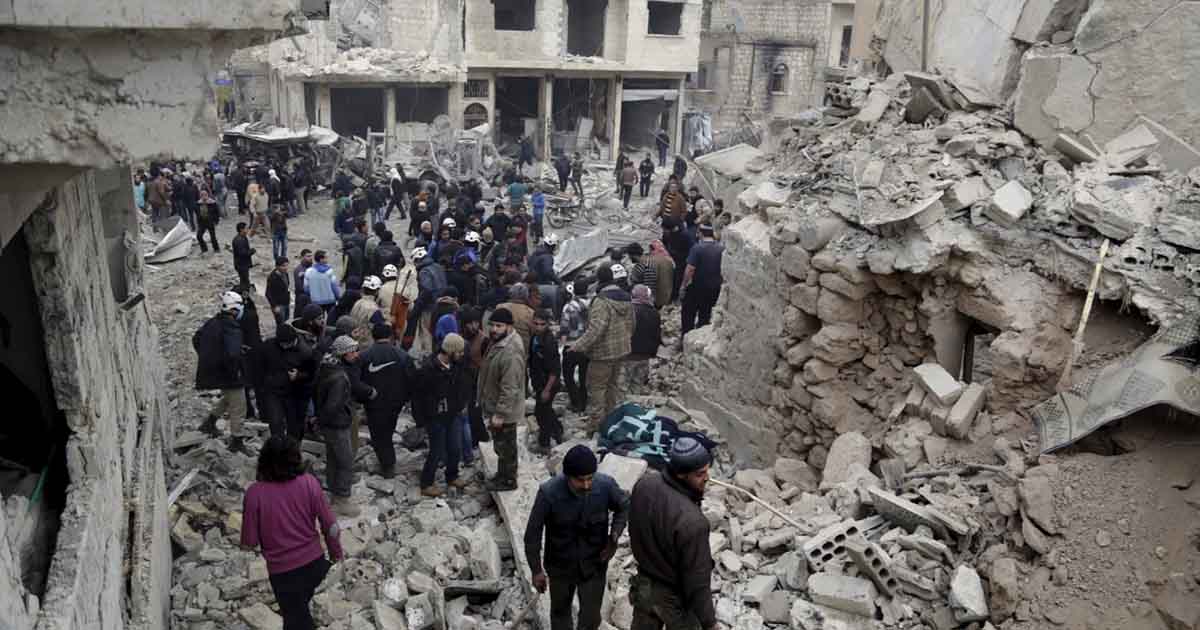
The economic starting point is catastrophic.
Human Rights Watch cited a World Bank estimate placing Syria's physical war damage at approximately $108 billion, with average reconstruction costs estimated around $216 billion and a possible range of $140 billion to $345 billion.Human Rights Watch
The World Bank originally projected approximately 1 percent GDP growth in 2025 after a 1.5 percent contraction in 2024, while later high-frequency data suggested stronger growth of roughly 2 to 4 percent.World Bank
The economic environment improved as sanctions were relaxed and foreign investment resumed, but severe infrastructure damage, poverty and weak institutions remained.
Sanctions Were Fundamentally Rewritten
The United States ended comprehensive Syria sanctions effective July 1, 2025.
OFAC removed the broad Syria sanctions framework while retaining targeted restrictions against Bashar al-Assad, his associates, human-rights abusers, Captagon traffickers, ISIS, Al-Qaida affiliates, Iran-linked actors and other destabilizing individuals or entities.U.S. Department of the Treasury
The Caesar Act was later repealed in December 2025, and in August 2026 the United States removed Syria's state-sponsor-of-terrorism designation and HTS's remaining terrorism designation.Office of Foreign Assets Control
This represented one of the most dramatic sanctions-policy reversals in the Middle East.
Reconstruction Capital Is Arriving Faster Than the Legal Framework
By September 2026, billions of dollars in reconstruction commitments had been announced.
Human Rights Watch reported:
Saudi Arabia: approximately $6.4 billion pledged across infrastructure, energy, telecom and real estate.
Qatar: approximately $4 billion in commitments.
UAE / DP World: a 30-year Tartous port concession.
European Union: approximately €620 million planned for humanitarian and socioeconomic support for 2026 and 2027.
The World Bank had approved more than $1 billion in grant-funded projects.Human Rights Watch
The problem is governance.
HRW warned that reconstruction contracts were moving ahead without adequate systems for property restitution, compensation, consultation and dispute resolution.Human Rights Watch
This creates a new human-rights risk.
People who lost homes under Assad-era expropriation laws could potentially lose them again through redevelopment.
E-Commerce and Quarterly Digital Losses
There is no credible audited dataset providing exact quarterly Syrian e-commerce losses caused specifically by censorship or internet interruption during 2025 or 2026.
Therefore, figures such as:
Q1 = $X million
Q2 = $Y million
should not be manufactured.
Syria's digital economy remains too fragmented, and public commercial data are not sufficiently complete to support such precision.
The more defensible economic indicators concern reconstruction, telecommunications investment, payment modernization, port traffic, energy supply and overall GDP recovery.
The September 2026 Energy Sabotage Incident
One of the freshest infrastructure-security developments occurred on September 28, 2026.
Syrian authorities said an explosion damaged a gas pipeline between al-Shola and Deir al-Zour, forcing the suspension of gas flows from the Jbeissa plant to power-generation facilities. The state petroleum company described the incident as sabotage.Reuters
The incident demonstrates how fragile Syria's recovery remains.
A single attack on energy infrastructure can reduce gas pressure, interrupt electricity generation and disrupt industrial activity.
Critical infrastructure security is therefore inseparable from economic recovery.
Captagon: From State-Linked Economy to Post-Assad Enforcement Problem
Under Assad, Syria became a major global Captagon production and trafficking center.
U.S. Treasury actions documented networks involving Assad-linked businessmen, military figures, financial facilitators and commodity businesses.U.S. Department of the Treasury
When Washington lifted comprehensive sanctions in 2025, it deliberately retained targeted sanctions against Captagon traffickers.U.S. Department of the Treasury
This distinction matters.
The fall of Assad did not automatically dissolve the trafficking networks created during his rule.
Smuggling routes, laboratories, financiers, brokers and regional criminal connections can survive regime change.
Crypto-Forensics and ISIS
One of the strongest current Syria-related crypto-finance cases appeared in June 2026.
The U.S. Treasury sanctioned individuals and entities involved in financing ISIS.
Among them was Bitcoin Xchange, a Syria-based money-services business that Treasury said transferred funds for ISIS associates in multiple countries.U.S. Department of the Treasury
OFAC also publicly identified two TRON addresses associated with designated ISIS facilitator Miloud Abderrahmane:
TBXMiRqUp1XH1zLazWu8cWitMAScv4HsYq
TDFj8tYzfLDkwEMo4MJ2DfrbpMztuCCnanOffice of Foreign Assets Control
These addresses are significant because they provide officially attributed starting points for blockchain investigation.
What Crypto-Forensics Can Establish
Once an address is officially attributed, investigators can examine:
First-hop counterparties, repeated transfer partners, exchange deposit clusters, bridges, token swaps, stablecoin usage, timing patterns and exposure to sanctioned wallets.
But an address interacting with a sanctioned wallet does not automatically become an ISIS wallet.
Attribution must remain evidence-based.
Russia's Continuing Strategic Position
Russia's role in Syria changed dramatically after Assad's fall but did not disappear.
In August 2026, Syria and Russia reached an understanding concerning the future of Russia's Tartous and Hmeimim bases, after approximately 18 months of negotiation. Syrian authorities would assume greater management of civilian facilities, while broader Russian military arrangements remained subject to agreement.Internazionale
Russia also moved toward establishing a commercial logistics hub at Tartous, with plans to handle up to 250,000 tons of cargo per month.Reuters
This represents adaptation rather than complete withdrawal.
Moscow is attempting to convert some of the leverage acquired under Assad into post-Assad commercial and strategic influence.
Iran Lost the Most
Iran was one of Assad's principal military supporters.
The collapse of the former government severely weakened Tehran's land-based network through Syria and disrupted structures associated with the IRGC and allied militias.
Unlike Russia, Iran has had much greater difficulty rebuilding an official relationship with the new Damascus leadership.
Therefore, Syria's current connection to the Iron Triangle is asymmetric.
Russia retains negotiated strategic access.
China may pursue commercial opportunities.
Iran lost much of the political-security infrastructure it had built under Assad.
China Is Not Equivalent to Russia or Iran in Syria
China maintains diplomatic and economic interests in Syria and could participate in reconstruction.
But available 2025 to 2026 evidence does not establish a Chinese security or militia role comparable to Iran's former presence or Russia's military bases.
The three states should therefore not be treated as interchangeable simply because they form the analytical Iron Triangle.
In Syria, their footprints differ fundamentally.
PART IV: SYRIA'S NEW SOVEREIGNTY TEST, EUROPEAN AND U.S. SECURITY, ISIS, FOREIGN MILITARIES AND HUMANIZING A DESTROYED STATE
Syria's Most Important Question Is No Longer Who Won the War
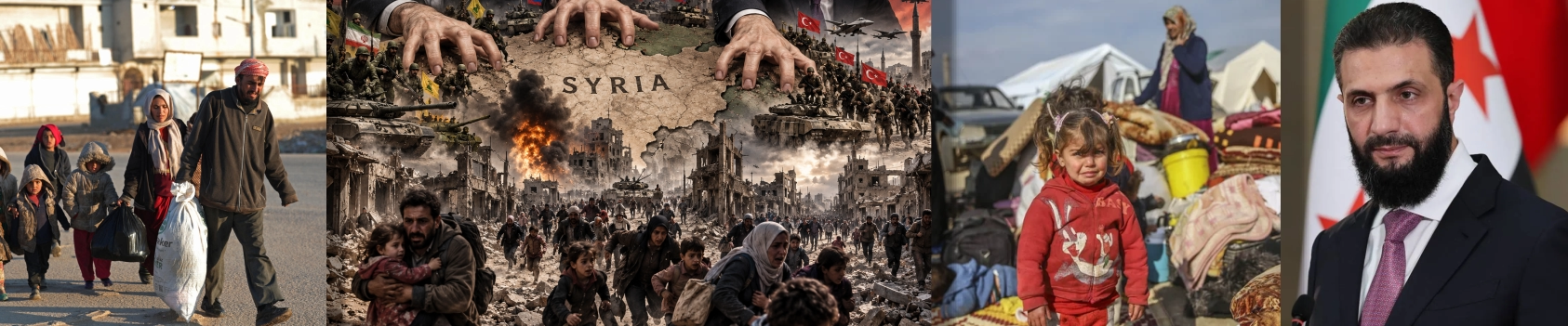
By late 2026, the more important question is:
Who controls the postwar state?
Several armed, political and foreign actors still influence Syrian territory.
The transitional government controls most national institutions.
The SDF is undergoing phased integration.
Türkiye retains deep security influence in the north.
Russia continues negotiating strategic and commercial access.
Israel maintains forces and conducts military operations in southern Syria.
The United States remains involved through counter-ISIS cooperation.
ISIS itself remains active.
Syria is therefore unified politically on paper more rapidly than it is unified militarily on the ground.
The Kurdish Integration Agreement
The January 2026 agreement between Damascus and the SDF is one of the most consequential developments since Assad's fall.
The agreement provided for incorporation of SDF military and civilian institutions into the Syrian state, transfer of oil fields and border crossings to Damascus and recognition of Kurdish cultural and linguistic rights.Syrian Arab News Agency (SANA)
If implemented successfully, it could resolve one of the most dangerous unresolved territorial disputes in Syria.
If mishandled, it could generate another major war.
Israel's Expanding Military Presence
Following Assad's fall, Israeli forces moved deeper into the UN-monitored separation area in southern Syria and established multiple military positions. Human Rights Watch documented nine Israeli posts extending through areas of Quneitra and Mount Hermon.Human Rights Watch
At the UN General Assembly in September 2026, President al-Sharaa claimed that Israel had carried out more than 500 air and artillery attacks, 1,200 ground incursions and nearly 300 detentions since the transition began. These figures are Syrian government claims and have not all been independently verified.AP News
Their political impact is nevertheless substantial.
External military pressure complicates Damascus's attempt to present itself as the uncontested sovereign authority.
Türkiye's Position
Türkiye remains one of the most influential external actors in northern Syria.
Turkish-backed armed factions played an important role in the fall of Assad, and Türkiye subsequently signed a military-cooperation memorandum with the transitional authorities.Human Rights Watch
Ankara's central concern remains Kurdish armed organizations it associates with the PKK.
Therefore, the SDF integration process is not merely a Syrian internal negotiation.
It directly affects Turkish national-security policy.
ISIS Remains the Transnational Threat
ISIS no longer controls a territorial "caliphate," but its financial and organizational structures have not disappeared.
The June 2026 Treasury action targeting Syria-based Bitcoin Xchange and other facilitators demonstrates that ISIS is still experimenting with transnational financial infrastructure, including cryptocurrency.U.S. Department of the Treasury
This matters directly to Europe and the United States because funds can move through multiple jurisdictions without requiring fighters themselves to cross borders.
The threat pathway can be:
European donor, cryptocurrency address, intermediary service, Syrian facilitator, regional ISIS network.
Europe Faces Three Syria Risks at Once
Europe's Syria problem now has three distinct dimensions.
Security: ISIS networks and radicalized individuals remain capable of operating transnationally.
Migration: millions of Syrians remain refugees while European governments debate returns.
Reconstruction: European companies and governments are becoming financially involved in projects where property ownership, displacement and compensation remain unresolved.
These are interconnected.
Premature refugee returns into areas without housing, electricity, healthcare or legal title can create new instability.
At the same time, permanent exclusion of Syrians from Europe is not a substitute for rebuilding safe conditions inside Syria.
The United States Faces a Different Set of Risks
The United States' main concerns include:
ISIS resurgence, protection of remaining U.S. personnel, Syrian control of detention camps, regional Iranian networks, Russian military access and security of reconstruction supply chains.
The transition also creates commercial opportunities for American firms.
But those opportunities bring compliance risks.
Sanctions were lifted broadly, yet targeted restrictions remain against Assad associates, ISIS, Captagon traffickers, Iran-linked networks and human-rights abusers.Office of Foreign Assets Control
A company investing in Syria therefore still needs serious beneficial-ownership screening.
Humanizing Digital and Infrastructure Failure
Syria illustrates a broader principle:
A modern humanitarian emergency is partly a network emergency.
Hospitals require:
Electricity, telecommunications, digital medical records, pharmacy supply chains, laboratory communication and payment infrastructure.
Water systems need electricity.
Electricity plants need fuel.
Fuel pipelines need physical security.
Internet providers need functioning backbone routes.
When one layer collapses, the disruption can propagate.
The September 2026 gas-pipeline sabotage illustrates this chain directly.Reuters
Can Internet Disruption Directly Cause Death?
It can create conditions that increase medical risk.
But a serious report should not claim that a specific Syrian internet outage caused a defined number of deaths without patient-level evidence.
The stronger documented problem is broader:
Destroyed hospitals, electricity shortages, weak telecommunications, displacement and shortages of medical services can interact to delay treatment and increase mortality risk.
Human Rights Watch documented returned communities in 2026 with no reliable electricity, water, schools or nearby medical facilities.Human Rights Watch
Sensitive Data and Foreign Service Providers
As Syrian institutions rebuild, medical, telecommunications and government data may increasingly be processed through international vendors.
That creates legitimate security questions:
Who owns the vendor?
Where are servers located?
Which subcontractors have administrative access?
Which jurisdictions govern disclosure?
Is data encrypted at rest and in transit?
Are sessions recorded?
Can administrators access patient or government records?
But there is currently no credible evidence establishing a broad Syrian government program that uses overseas translation or healthcare vendors to spy on Western officials.
Risk analysis should not be converted into an unsupported accusation.
Reconstruction Can Become a New Form of Dispossession
One of the most important and newest risks does not involve bombs or intelligence services.
It involves land.
Assad-era laws such as Decree 66 and Law No. 10 allowed major redevelopment projects to proceed while displaced people struggled to prove ownership.
Human Rights Watch reported in September 2026 that some of those legal structures remain unresolved and that reconstruction decisions are already generating protests.Human Rights Watch
This creates the possibility that Syrians who lost homes during war could lose their property rights during peace.
That would transform reconstruction from recovery into a second displacement.
The Iron Triangle and Syria
The Iron Triangle remains:
China, Russia, Iran.
Syria sits outside it.
Before December 2024, Assad's government depended heavily on two vertices, Russia and Iran.
After Assad's fall:
Iran's influence declined sharply.
Russia preserved part of its military and commercial position through negotiation.
China remained a potential economic and infrastructure partner but without the equivalent military footprint.
Thus Syria should not be treated as subordinate to one unified three-state bloc.
The post-Assad environment is increasingly competitive and multipolar.
The Strategic Turning Point
Syria in 2026 is moving from a war economy toward a reconstruction economy.
That transition is potentially more consequential than any single military battle.
Billions of dollars in contracts will determine:
Who owns ports, who rebuilds electricity, who supplies telecom infrastructure, who controls fiber routes, who receives land, who returns home and which foreign powers acquire long-term influence.
The political battle over Syria is therefore changing form.
It is moving from front lines toward:
Contracts, ports, property registries, fiber networks, energy corridors, banking relationships and institutional appointments.
Final Assessment
Syria's 2025 to 2026 transition is neither a simple democratic success nor a continuation of the Assad system.
It is an unresolved state-building process.
The fall of Assad ended a government responsible for systematic torture, disappearance and mass repression.
But the new order quickly confronted its own human-rights crises.
Alawite civilians were massacred on the coast. Druze communities suffered mass violence in Sweida. Arbitrary detention continued. The judiciary remained institutionally weak. Women remained underrepresented. Kurdish integration remained fragile. Foreign militaries retained influence. ISIS financial networks persisted.
At the same time, Syria reopened economically.
Sanctions were lifted. International finance resumed. New submarine cables were announced. Gulf investment returned. Ports and energy infrastructure became strategic assets.
This combination creates both opportunity and danger.
The central investigative priorities are therefore:
Follow the court records, follow the missing-person files, follow the militia chains of command, follow reconstruction contracts, follow land ownership, follow telecom procurement, follow router serial numbers, follow customs records, follow port concessions, follow crypto wallets and follow foreign military agreements.
The next phase of Syrian power will increasingly be written in contracts, databases and infrastructure, not only on battlefields.
Sources and Reference Material
Human Rights Watch, World Report 2026: Syria
Human Rights Watch, Syria: First Assad-Era Verdicts a Test for Justice, August 23, 2026
Reuters, Syria Sentences Bashar al-Assad to Death, August 11, 2026
Reuters Investigation, March 2025 Alawite Killings
Reuters, Syria-SDF Integration Agreement, January 30, 2026
Reuters, Syria's New Parliament Meets, July 12, 2026
Reuters, Sweida Reintegration Stalled, June 22, 2026
Human Rights Watch, Syria Reconstruction Deals Lack Critical Rights Framework, September 27, 2026
World Bank, Syria Economic Challenges and Recovery Prospects, July 2025
World Bank, Syria Country Economic Update
U.S. Treasury, Termination of Comprehensive Syria Sanctions, June 30, 2025
OFAC, Promoting Accountability for Assad and Regional Stabilization Sanctions
OFAC, Syria Sanctions Program Changes
Citizen Lab, Behind Blue Coat: Commercial Filtering in Syria
Syrian Ministry of Communications, Syria-Cyprus Ebla Submarine Cable, September 13, 2026
Syrian-Jordanian Telecommunications Cooperation
U.S. Treasury, ISIS Financial Facilitators, June 22, 2026
OFAC, ISIS Crypto Wallet Designations, June 22, 2026
Reuters, Russian Commercial Logistics Hub at Tartous, July 9, 2026
Reuters, Russia-Syria Agreement on Tartous and Hmeimim Bases, August 2026
Reuters, Syria Gas Pipeline Sabotage, September 28, 2026
AP, Syrian President Addresses UN and Israeli Military Activity, September 2026
Research, investigation, compilation and preparation by the Editorial Team.